
Guides
What is IPTV? The Ultimate Guide for Beginners in 2026
Learn everything you need to know about Internet Protocol Television (IPTV). Discover how it works, why millions are cutting the cord, and how to choose a safe, premium provider in 2026.
Loading StreamVexa...
Quick access to our expert setup guides, region-specific channels, provider comparisons, and latest tutorials.
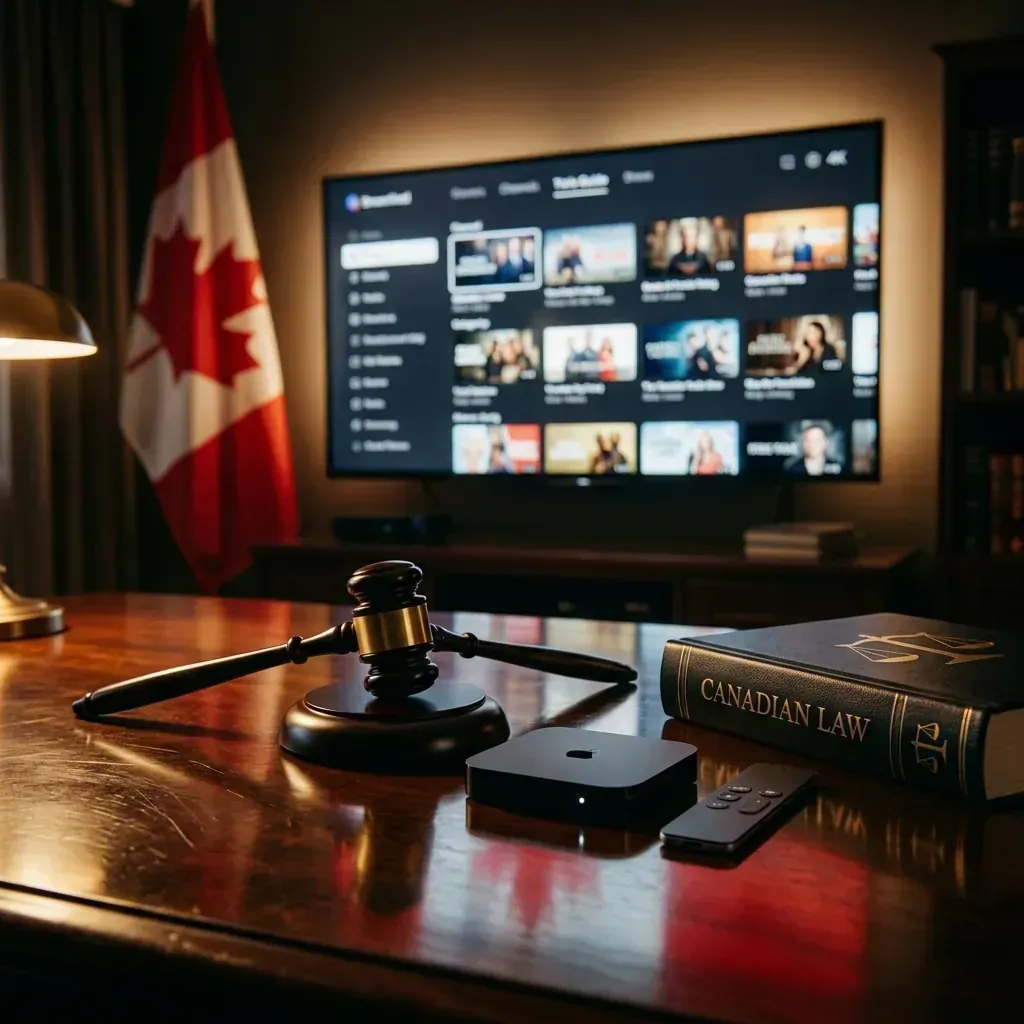
Everything Canadian viewers need to know about IPTV legality in 2026. Covers CRTC regulations, Copyright Act implications, and how to stream safely and responsibly.
Join 15,000+ others who switched to our Anti-Freeze technology. Get instant access to 25,000+ channels in 4K starting from just 3 months.
It's the single most Googled question in the Canadian streaming space: "Is IPTV legal in Canada?"
And it deserves a real answer — not the vague "it depends" that most articles give you, and not the fear-mongering "you'll go to jail" nonsense from cable company blogs that have a vested interest in keeping you subscribed to their $150/month packages.
Over 3 million Canadians use some form of IPTV service in 2026. Bell, Rogers, and Telus all deliver their own TV products using IPTV technology. Netflix runs on IPTV technology. So does Crave, Disney+, and every other streaming service you've ever used.
The question isn't whether IPTV technology is legal — it is. The question is what the Canadian legal framework actually says about different types of IPTV services, and what that means for you as a viewer.
This guide breaks it all down — the relevant Canadian laws, the CRTC's actual position, real enforcement examples, the difference between distributing and viewing, and practical advice for Canadians who want to make informed decisions about their streaming choices.
Before we discuss legality, let's establish what we're actually talking about — because the term "IPTV" is used to describe very different things.
IPTV (Internet Protocol Television) is simply a method of delivering television content over the internet rather than through traditional cable, satellite, or antenna signals. That's all it is — a delivery mechanism.
| Type | Examples | How It Works | |---|---|---| | Telco IPTV | Bell Fibe TV, Rogers Ignite TV, Telus Optik TV | Cable companies deliver their TV packages over internet infrastructure instead of coaxial cable. Requires a contract. | | Licensed Streaming | Netflix, Crave, Disney+, TSN Direct, Sportsnet+ | Companies license content and deliver it via internet apps. Subscription-based. | | Third-Party IPTV | Various independent providers | Services that aggregate live TV channels and VOD content, delivered via internet to standard IPTV player apps. Subscription-based. | | Free IPTV / M3U Lists | Various websites and forums | Unverified, often unstable channel lists shared freely online. No subscription needed. |
Every single one of these uses IPTV technology. Bell Fibe TV is IPTV. Netflix is IPTV. Crave is IPTV.
The technology itself is completely neutral — just like a web browser can be used to visit a bank's website or a scam website. The tool isn't the issue; how it's used is what matters.
💡 Want a deeper technical understanding? Read our comprehensive guide to IPTV basics — it explains how the technology works under the hood.
Yes — IPTV technology is 100% legal in Canada. Using IPTV to watch television is not a criminal act. There is no Canadian law that prohibits individuals from using IPTV technology to receive and view content.
The nuances emerge around:
Let's break down each of these in detail.
Three key pieces of Canadian legislation are relevant to IPTV:
Canada's Copyright Act is the primary legislation governing intellectual property rights for creative works, including television broadcasts.
Key provisions relevant to IPTV viewers:
Section 29.22 (Reproduction for Private Purposes): Canadians have the right to make temporary reproductions of content for private use. Streaming inherently creates temporary copies in your device's memory (buffer). This is not considered "copying" in the traditional copyright sense.
Section 27 (Infringement): Copyright infringement in Canada requires an act of reproduction, distribution, or public performance without authorization. Simply viewing a stream does not constitute reproduction or distribution under most legal interpretations.
The "making available" right: Canadian copyright law targets those who make content available to the public — i.e., the distributors and operators of services — not the individuals who consume it.
What this means for viewers: The Copyright Act's enforcement mechanisms are designed to target commercial-scale distributors, not individual consumers watching content on their living room TVs.
The Broadcasting Act gives the CRTC authority to regulate broadcasting in Canada.
Key points:
Canada's Criminal Code does not contain any provision that criminalizes the act of watching a stream, regardless of the source. There is no "watching illegal content" offence for standard television programming.
Criminal enforcement is reserved for large-scale commercial piracy operations — organizations that profit from distributing unauthorized content at scale.
The Canadian Radio-television and Telecommunications Commission (CRTC) is the federal regulatory body responsible for broadcasting and telecommunications in Canada.
The CRTC has consistently taken the position that:
IPTV technology is a legitimate delivery mechanism — Bell, Rogers, and Telus all operate CRTC-licensed IPTV services (Fibe TV, Ignite TV, Optik TV)
The CRTC regulates services, not users — No CRTC enforcement action has ever targeted an individual consumer for watching IPTV content
The focus is on commercial distributors — The CRTC's investigations and enforcement actions target unauthorized broadcasting distribution undertakings (BDUs), not end-users
The regulatory landscape is evolving — Bill C-11 (Online Streaming Act) gave the CRTC new tools to regulate online streaming platforms, but this remains focused on large platforms (Netflix, Crave, YouTube, etc.) and their Canadian content obligations — not individual viewers
| Entity | CRTC Action | Risk to Individual Viewer | |---|---|---| | Licensed broadcasters (Bell, Rogers) | Fully regulated, licensed | None | | Netflix, Disney+, etc. | Regulated under C-11 for CanCon obligations | None | | Third-party IPTV providers (large-scale) | May face CRTC/legal action if distributing without authorization | None (you're the viewer) | | Individual viewers | No CRTC action ever taken against a viewer | Effectively zero |
This is the single most important legal concept for Canadian IPTV users to understand.
In Canada's legal framework, the viewer and the distributor are treated as completely different actors with completely different levels of responsibility:
Distributors (Providers):
Viewers (Consumers):
Think of it this way: If someone throws a party and plays music without a performance license, the party host is liable — not the guests who heard the music. Canadian copyright enforcement works on the same principle. The entity providing the content bears the legal burden, not the individual consuming it.
Since the Copyright Modernization Act of 2012, every major Canadian enforcement action has followed this pattern:
Let's look at what has actually happened in Canada to understand where the legal risks really lie:
Major Canadian broadcasters sought and obtained Federal Court orders to block specific domain names associated with large-scale unauthorized IPTV services.
Canadian courts issued injunctions against retailers selling pre-loaded Android boxes marketed for accessing unauthorized content.
The CRTC has investigated several operations providing unauthorized TV distribution in Canada.
In every single Canadian case — civil, criminal, or regulatory — the enforcement target has been the provider, distributor, or commercial reseller. No individual Canadian has been prosecuted, fined, or taken to court for watching an IPTV stream on their personal device.
Given the legal framework, here's a practical guide to understanding the spectrum of IPTV legality in Canada:
🔒 Concerned about the safety of free M3U links? Read our in-depth guide on IPTV safety and the dangers of free streams — it covers malware, data theft, and how to protect your network.
Whether you're concerned about legality, security, or simply quality — these are the signals that separate reputable providers from risky ones:
📋 Use our complete IPTV provider evaluation checklist to compare providers side by side.
Regardless of which IPTV service you choose, these practices keep your streaming experience secure:
Stick to well-known, trusted apps:
Avoid unknown "all-in-one" apps that bundle a player with built-in content — these are the ones most likely to carry malware or hidden advertising.
A VPN encrypts your internet traffic and prevents your ISP from seeing what you're streaming. This is useful because some Canadian ISPs throttle streaming traffic during peak hours.
VPN benefits for IPTV:
📡 Experiencing buffering that might be ISP-related? Read our guide on how to fix IPTV buffering and ISP throttling.
Outdated firmware on Fire TV Sticks, Android boxes, and Smart TVs can have security vulnerabilities. Enable automatic updates on your devices.
As a rule: If you're not paying for it, you are the product. Free M3U links from random websites expose you to:
The From $13.33/month you spend on a premium provider is the cost of a safe, reliable experience.
Understanding how premium IPTV services operate helps explain why they can offer so much content at prices that seem "too good to be true":
Canadian cable companies carry enormous overhead costs:
All of these costs are passed directly to you in your monthly bill. When you pay $150/month for Rogers Ignite TV, you're funding a massive corporate infrastructure — not just the TV content you watch.
Premium IPTV providers operate with a fundamentally different cost structure:
The result: the same content (or more) can be delivered at a fraction of the cost. The savings are real, and they're passed on to subscribers.
StreamVexa was built to be the kind of service that smart, informed Canadians feel confident using:
15,000+ live channels — Complete Canadian lineup (TSN 1-5, all Sportsnet regionals, CBC, CTV, Global, French-language Quebec channels) plus international content from 100+ countries. Browse the full lineup on our channels page.
100,000+ VOD titles — Movies, TV series, documentaries, and kids' content. Updated daily.
4K UHD quality — Crystal-clear streams with anti-freeze technology for buffer-free viewing during peak events. Learn more about IPTV quality and 4K streaming.
Multi-connection plans — One subscription covers up to 4 devices simultaneously. Read our multi-connection IPTV guide.
Works with trusted apps — TiviMate, IPTV Smarters Pro, IBO Player Pro — all established, well-reviewed IPTV players. No suspicious custom app required.
24/7 live support — Real humans responding in minutes.
No contracts — Monthly billing. Cancel anytime. No cancellation fees.
7-Day Money-Back Guarantee — StreamVexa offers a 7-Day Money-Back Guarantee — no risk, no obligation. Test every channel, every feature, and every claim in this article. If it's not better than what you're currently paying for, you've lost nothing. Instant activation.
🇨🇦 See how StreamVexa compares to other Canadian IPTV options? Read our Best IPTV in Canada 2026 rankings.
Let's summarize the facts:
IPTV technology is legal in Canada. Bell, Rogers, Netflix, and Crave all use it.
Canadian law differentiates between providers and viewers. Enforcement targets distributors, not consumers. No individual Canadian viewer has been prosecuted for watching an IPTV stream.
The CRTC regulates services and platforms, not individual users. The CRTC has never taken action against a viewer.
The Copyright Act's provisions around streaming focus on reproduction and distribution — not on the act of receiving and viewing a stream.
The regulatory landscape is evolving — The Online Streaming Act (Bill C-11) gave the CRTC new regulatory tools, but these are aimed at large platforms, not consumers.
The biggest real risk for viewers is security, not legality. Free M3U links and shady "all-in-one" apps are the actual threat — through malware, data theft, and device compromise. Premium services mitigate these risks entirely.
Make informed decisions. Choose reputable providers. Protect your devices and personal data. And enjoy the fact that watching television in Canada has never been more affordable or accessible.
👉 Start Your Premium Plan — Risk-Free 7-Day MB Guarantee
/blog/is-iptv-legal-canada-2026Learn everything you need to know about Internet Protocol Television (IPTV). Discover how it works, why millions are cutting the cord, and how to choose a safe, premium provider in 2026.

Tired of buffering at the worst moment? Discover the best premium IPTV service of 2026 that actually delivers 4K sports and VOD without the freezing.

Looking to jailbreak your Firestick in 2026? Stop. Free APKs buffer and carry malware. Follow these 5 safer steps to set up a premium, buffer-free live TV experience.